Shopping Around Tariffs: The Cart-Level Guide to Trade Pressure in 2026
The practical companion to our tariff playbook: which aisles still feel indirect trade pressure, and which swaps and seasonal choices offset it.
Update, October 2026: this guide reflects trade policy as of April 2026. Canada has since put new counter-tariffs on $27.6 billion of U.S. goods, including dairy products and honey, effective September 8, 2026. Check the current list before you rely on the details below.
Open a Canadian fridge in winter and plenty of what's inside has crossed a border: strawberries from California, avocados from Mexico, breakfast cereal made with American corn.
When trade policy changes, that fridge can get more expensive. The Canadian side shifted on September 1, 2025, when Canada removed its counter-tariffs on U.S. goods covered by CUSMA, including food and beverages, and kept its tariffs on steel, aluminum and autos.
So in 2026 the tariff story for Canadian shoppers is mostly indirect pressure (packaging, logistics, uncertainty), not aisle-wide food tariffs.
Here's what that means for grocery prices, which categories to watch, and how to plan around it. For the policy-level breakdown, see The 2026 US-Canada Tariff Playbook.
The short version
Tariffs are taxes on imported goods. When one applies, the importer pays it and usually passes it to the wholesaler, who passes it to the retailer, who passes it to you. Each step can add its own markup on top.
The Canadian side of the 2025–2026 story has moved in two phases:
- Early 2025: Canada applied 25% counter-tariffs to a broad list of U.S. goods. The March 4, 2025 list included peanut butter, orange juice, ketchup, mayonnaise and whisky.
- September 1, 2025: Canada removed those counter-tariffs, including on food and beverages. The remaining measures cover steel, aluminum and autos, which affect grocery prices only indirectly.
For a 2026 shopper, the broad food-tariff wave from early 2025 has been withdrawn. Prices didn't snap back to pre-2025 levels, because other forces were also pushing costs up: food bought from stores was still up 4.1% year over year in February 2026.
Four forces still shaping your 2026 grocery bill
Even with food tariffs removed on the Canadian side, four pressures remain:
- Indirect trade-policy effects: steel, aluminum and auto measures flowing into packaging, refrigeration and logistics equipment, plus an uncertainty premium on cross-border trade.
- Currency swings. The loonie was weak in early 2025, at about 70 U.S. cents. It firmed to about 73 cents by February 2026 (Bank of Canada), which helps on anything invoiced in U.S. dollars.
- Higher freight and energy costs from oil-market disruption tied to the Strait of Hormuz. Canadian retail diesel rose 67.4 cents a litre in March 2026.
- Weather and harvests abroad, which move produce, coffee and olive oil prices regardless of trade policy.
Each one can raise prices on its own. Together they explain why some categories kept climbing after the food tariffs were withdrawn.
Categories most exposed to remaining trade pressure
Some categories depend heavily on imports and feel upstream changes quickly. Others are insulated by domestic production or supply management.
Fresh produce (high exposure: currency and seasonality)
A large share of the fresh fruit and vegetables Canadians eat in winter comes from the United States and Mexico, priced in U.S. dollars. The 2026 pressure here is currency, freight and weather, not active tariffs. When the loonie weakens, imported produce costs more.
Packaged foods with steel or aluminum inputs (medium exposure, indirect)
Canned goods, drinks in metal containers, pet food and shelf-stable products use steel and aluminum packaging. Canada's remaining tariffs on U.S. steel and aluminum touch these inputs, and some of that works its way into wholesale food prices over time.
Dairy (low direct exposure)
Canadian dairy is supply-managed, so milk, butter, cheese and yogurt prices are largely set at home. A 4-litre bag of milk averaged $6.96 in February 2026, up 3.1% from a year earlier, and block cheese was unchanged at $7.05 for 500 g (Statistics Canada).
Meat (high exposure, cycle-driven)
Beef and pork trade heavily across the Canada-U.S. border in both directions. Ground beef averaged $16.46/kg in February 2026, up 18.3% from a year earlier (Statistics Canada).
The main driver is a tight cattle supply. The U.S. herd was 86.2 million head on January 1, 2026, down from 86.5 million, and Canada's herd grew for the first time since 2018 after years of decline.
Chicken is mostly Canadian-supplied, but it hasn't been cheap either: a whole chicken averaged $8.57/kg in February 2026, up from $5.96 a year earlier.
Pantry staples (variable exposure)
Coffee, olive oil, pasta and tea are mostly imported, and their prices move with global harvests and currency more than with Canada-U.S. trade policy. In February 2026, a 340 g bag of coffee averaged $9.51, up 30% from a year earlier, while a litre of olive oil fell 18% to $11.24 (Statistics Canada).
The categories that stay stable
These rose less than the 4.1% overall food rate between February 2025 and February 2026 (Statistics Canada average prices):
- Flour and bread: wheat flour up 2.3%, white bread up 3.4%.
- Eggs: $4.81 a dozen, down 2%.
- Pulses: dried lentils down 4.3%, dry beans flat.
- Butter and block cheese: flat.
- Storage vegetables: potatoes, carrots, onions and cabbage are Canadian-grown through winter and into spring.
- Frozen vegetables: less exposed to fresh-import disruption.
If your weekly bill is dominated by imported produce and premium packaged goods, you're more exposed to the pressures still in the system. Shifting even 30% of your shopping toward Canadian-grown and supply-managed staples reduces that exposure.
Substitution: the highest-leverage move
Most budget advice says "shop the sales." That helps, but when imported categories are up, the bigger win is changing what you cook with.
Swaps that work:
- Spinach is up? Buy frozen spinach for cooking. Use cabbage or napa for raw dishes.
- Avocados are up? Use hummus, white-bean spread or roasted red pepper as the creamy element in sandwiches and bowls.
- Fresh berries are up? Frozen strawberries averaged $5.22 for 600 g in February, less per kilogram than fresh, and they work in nearly every cooked or baked dish. Apples, pears and clementines are seasonal value picks.
- Bell peppers are up? Carrots and cabbage give crunch and bulk in stir-fries and salads. In February they averaged $2.66/kg and $2.51/kg, against $8.87/kg for peppers.
- Imported cheese is up? Canadian block cheese held flat at $7.05 for 500 g.
- Name-brand pantry staples feel expensive? Store brands like PC and no name usually cost less per unit.
The Canadian-grown, in-season alternative is often cheaper than its imported counterpart, and upstream friction widens that gap.
Seasonal eating saves real money
Canadian growing seasons are short, but each one has cheap categories you can build meals around. See our Spring 2026 seasonal guide for the current list.
Spring: asparagus, rhubarb, radishes and spinach, plus greenhouse cucumbers, tomatoes and peppers until field crops arrive. Ontario field strawberries arrive in June. Summer: berries, stone fruit, corn, tomatoes, zucchini, peppers. Almost everything fresh and local. Fall: apples, squash, root vegetables, brassicas (broccoli, cauliflower, cabbage), pumpkin. Winter: storage crops (potatoes, carrots, onions, cabbage, beets), greenhouse produce, frozen everything.
Eating what's in season locally usually costs less per serving than eating imported counterparts the same week.
Build half your weekly meals around Canadian-grown or supply-managed staples (chicken, eggs, dairy, root vegetables, frozen produce, oats, lentils). Save the imported items for the meals where they really matter. You'll reduce your exposure to whatever comes next in the trade cycle without eating the same thing every day.
Watching for the second wave
Even with direct food tariffs removed, trade-related pressure can arrive in waves. The first wave is a direct price change on affected inputs. The second, sometimes months later, is when manufacturers reformulate, re-source or shrink packages to protect margins. That's when shrinkflation creeps into categories that used to be stable.
Watch for smaller packages, "new recipe" labels, ingredient swaps (cheaper oils, more fillers) and "limited time" reformulations that quietly become permanent.
How to read trade headlines in 2026
As of April 2026, the broad food and beverage counter-tariffs Canada applied in early 2025 have been withdrawn. What's still in place (steel, aluminum and autos) affects grocery prices indirectly and on a longer lag.
Let weekly flyer prices and unit-price checks guide your basket, not the news cycle.
How Deal Dish helps
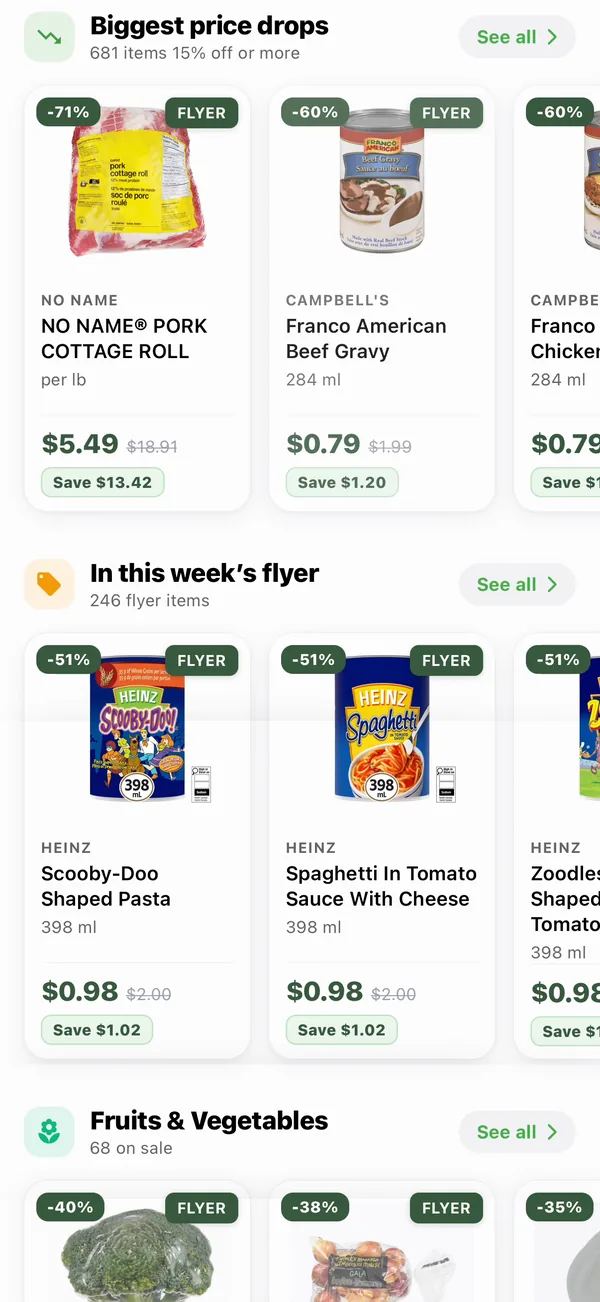
Deal Dish shows this week's flyer deals from 3,500+ Canadian grocery stores across 35 banners. When upstream costs push up one category, you can see which alternatives are on sale that week.
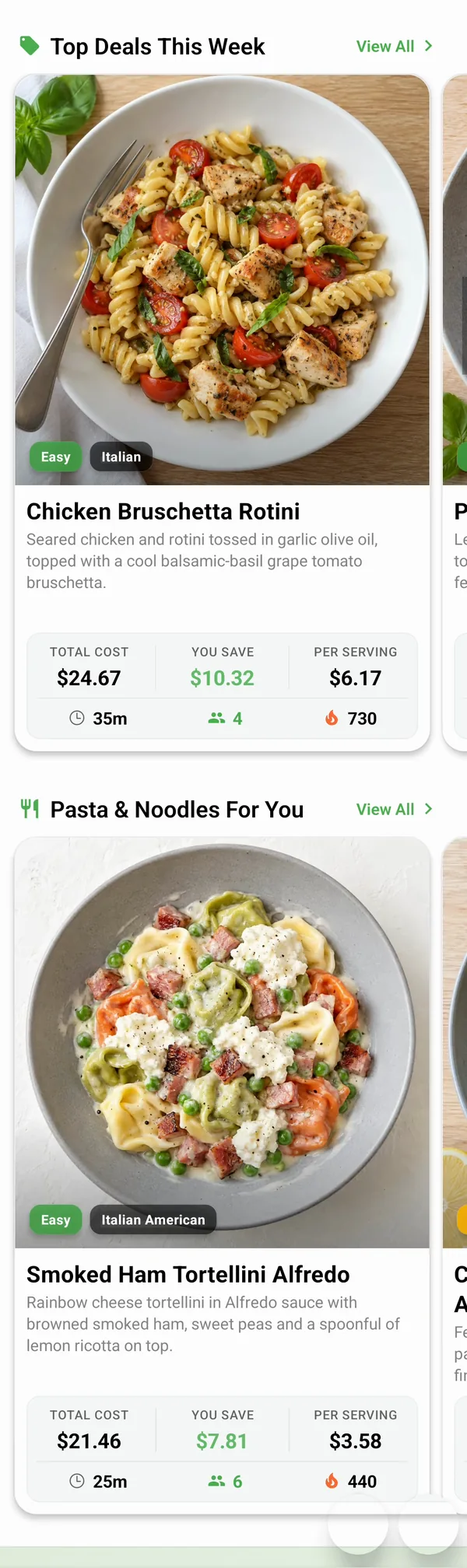
New recipes built from what's on sale arrive every Thursday, and each recipe card shows its cost per serving. In the aisle, the barcode scanner shows whether an item is on sale and what it costs at nearby stores.
See this week's grocery deals from 35 Canadian banners. Download Deal Dish free on the App Store.
Put this into practice
Deal Dish is a free app for iPhone, iPad and Android that collects weekly flyer deals from 3,500+ Canadian grocery stores. The same team writes these guides.