Shrinkflation in Canada: How to Spot It and Fight Back
Statistics Canada found 29.6% of tracked grocery items shrank between 2021 and 2023. How to spot it in Canadian stores and catch it with unit pricing.
The box of Kraft Dinner looks the same as it always has, at the same price. But it went from 225 g to 200 g in late 2023.
That's shrinkflation, and it has been chipping away at Canadian grocery budgets for years. With food prices from stores rising faster than overall inflation in 2026, it's worth knowing how to spot it. The shelf tag gives it away.
What shrinkflation actually is
Shrinkflation is when a manufacturer reduces the size or quantity of a product while keeping the price the same (or close to it). It's a price increase by another name.
Say a brand charges $5.49 for 200 g of cereal. Instead of raising the price, it quietly drops the bag to 175 g and keeps the $5.49 sticker. Per gram, you're paying more. Per package, you're paying the same.
Shrinkflation is harder to spot than a sticker-price increase, and it comes on top of the inflation you can see. Food bought from stores was up 4.1% year over year in February 2026, against 1.8% for overall inflation.
Statistics Canada has measured it. Its 2025 study found that 29.6% of eligible grocery items tracked in the Consumer Price Index shrank between 2021 and 2023. That's nearly one in three. Name brands accounted for 77.6% of the cases.
The federal Office of Consumer Affairs covers shrinkflation and per-unit pricing in its consumer guidance.
Why companies do it, and the 2026 cost pressures
Manufacturers face the same input-cost pressures shoppers do. Wheat, sugar, packaging, fuel and labour have all gotten more expensive.
In early 2026, the Middle East conflict pushed Canadian diesel up 67.4 cents a litre in March (see how that reaches your grocery bill). Canada's remaining counter-tariffs on U.S. steel and aluminum feed into packaging and processing costs, even though Canada removed its counter-tariffs on U.S. food and beverages on September 1, 2025 (more on tariffs).
When those pressures hit, manufacturers have three options:
- Raise the price. Shoppers notice and may switch to a competitor.
- Reformulate with cheaper ingredients. Sometimes possible (palm oil instead of butter, for example), but it often makes the product worse.
- Shrink the package. Same shelf presence, same brand recognition, margin restored.
Option three draws the least attention. Brands sometimes pair it with new packaging (a "fresh look" or "modern design") that reduces the volume while making the product look improved.
Real examples Canadians have seen
Documented Canadian cases from recent years:
- Kraft Dinner: 225 g to 200 g per box, confirmed by Kraft in 2023.
- Honeycomb cereal (family size): 595 g to 525 g, reported by CBC in 2023.
- Kraft salad dressing: 475 mL to 425 mL, noticed by shoppers in 2024.
- Classico pasta sauce: 650 mL to 600 mL, reported in late 2024.
StatCan's study found the most cases in margarine, pasta mixes, cookies and crackers, mozzarella, cereal and cheddar.
Shrinkflation vs. skimpflation
Shrinkflation is less quantity at the same price. Skimpflation is the same quantity with lower quality: cheaper oils, less cheese on a frozen pizza, a butter blend instead of butter, fewer nuts in a granola bar.
Both show up when input costs climb. For shrinkflation, the unit price is the tell. For skimpflation, check the ingredient list: if a product you've bought for years suddenly tastes off, see whether the ingredient order on the back has changed.
The unit-price test that catches it
One number on many Canadian shelf tags defeats shrinkflation: the unit price. It's the cost per 100 g, per 100 mL or per unit.
In Quebec, food stores that use shelf labels must show it by law. Elsewhere it's voluntary, so coverage varies by store. In January 2026 the federal government said its food security strategy will include unit price labelling.
It's the small number under the main price, often something like $1.27 / 100g. The big number gets the attention, but the unit price is the one that shows what you're paying.
When two products look like good deals, ignore the sticker price. Compare the per-100 g or per-100 mL number on the shelf tag. The lower number is the better buy.
This works for the same product across sizes ("is the family pack actually cheaper?") and across brands ("is the name brand really worse value than the store brand?").
It also reveals shrinkflation. If you remember a product at $1.10/100 g and it's now $1.35/100 g at the same package price, the package shrank.
Why "stock-up sizes" sometimes lie
The classic budget tip is "buy the bigger size, it's cheaper per unit." Usually true. But the family pack or jumbo box occasionally has a worse unit price than the regular size, especially when the regular size is on sale.
Don't assume. Check the shelf tag.
Spotting shrinkflation on the shelf
Beyond unit pricing, here are the patterns to watch for:
1. New packaging on a familiar product. "New look!" "Refreshed design!" When a brand redesigns the bag or box, check whether the size changed too. Compare with your last receipt or the unit price.
2. Slightly different shapes. A chip bag that's narrower at the bottom, a peanut butter jar with a deeper dimple in the base, cookies that are a little thinner.
3. "Sharing" or "snack" packs. A "snack pack" of crackers can be a smaller total weight split into little bags. Check the net weight against the package you used to buy.
4. Fewer items in a multi-pack. Twelve-packs that became ten-packs. Six-packs that became five.
5. "New recipe" claims. When a brand announces a reformulation, especially around "reduced saturated fat" or "improved texture", check the weight and the ingredient list.
The second wave: when shrinkflation follows cost shocks
Input-cost shocks from energy, packaging or trade friction can trigger a two-stage response. The first is the visible price increase. The second, sometimes months later, is when manufacturers reformulate or shrink packages to protect margins.
If a category got pricier in late 2025, watch it through 2026 for a quiet size drop.
Shrinkflation is easiest to catch where unit pricing is clear and comparisons are clean: pantry staples, frozen goods, dairy. It's harder with produce and variable-weight foods, where you're already comparing per kilogram.
How Deal Dish helps
Shrinkflation gets caught at the shelf tag, by comparing unit prices. Deal Dish helps with the price side.
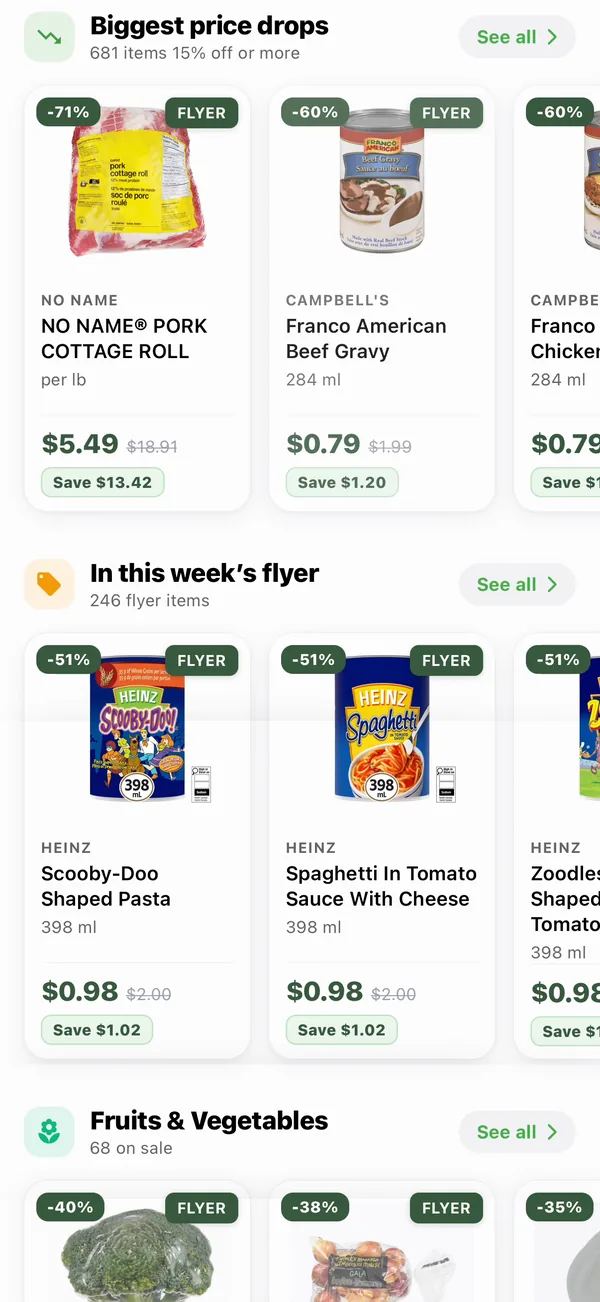
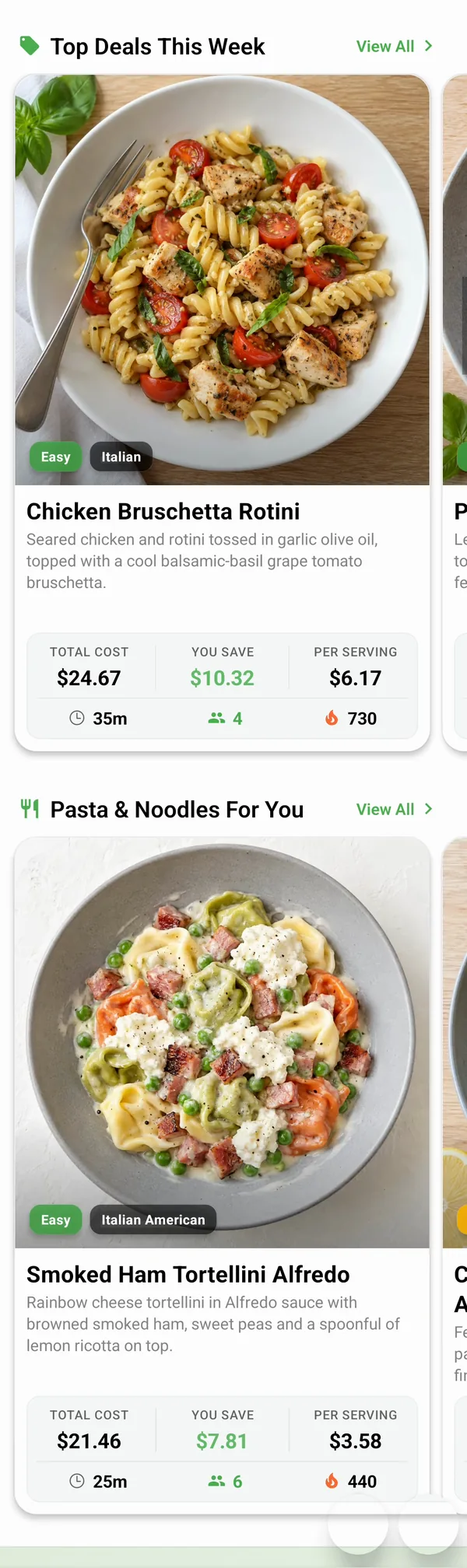
It shows this week's flyer deals from 3,500+ Canadian grocery stores across 35 banners. In the aisle, the barcode scanner shows whether an item is on sale and what it costs at nearby stores. It doesn't measure package size, so pair it with the unit price on the tag.
The bigger picture
As long as input costs rise and shoppers watch sticker prices more closely than unit prices, manufacturers will keep finding quiet ways to charge more. Your defence: read the unit price, compare across brands, and check the net weight instead of trusting the packaging design.
The next time you grab a bag that looks the same as always, flip it over and check the weight.
Check whether an item is on sale nearby before you buy it. Download Deal Dish free on the App Store.
Put this into practice
Deal Dish is a free app for iPhone, iPad and Android that collects weekly flyer deals from 3,500+ Canadian grocery stores. The same team writes these guides.