Why Your Grocery Bill Keeps Climbing: Canada's 2026 Food Inflation Explained
Store-bought food rose 4.4% in the year to March 2026, and the Food Price Report forecasts 4–6% for 2026. What's driving it, which aisles are worst, and what helps.
Headline inflation in Canada was 2.4% in March 2026, close to the Bank of Canada's 2% target. Food bought at stores rose faster: up 4.4% from a year earlier, with fresh vegetables up 7.8% (Statistics Canada).
Gasoline jumped 21.2% in a single month, the largest monthly increase on record, which Statistics Canada tied to the conflict in the Middle East.
If you spend $1,200 a month on groceries, a 4.4% increase is about $53 more a month than a year ago. That lands on top of a longer climb: food prices are 27% higher than five years ago, according to Canada's Food Price Report 2026.
Here's what's driving the climb in 2026, which categories are taking the worst of it, and the shopping habits that soften the hit.
Where the 2026 numbers actually sit
Three numbers to keep separate:
- Headline CPI: broad inflation across the economy. It was 2.4% in March 2026.
- Food purchased from stores: what you pay at the grocery store. Up 4.4% year over year in March 2026.
- Category-level moves: individual aisles can run much hotter. Fresh vegetables were up 7.8% in the same release.
Canada's Food Price Report 2026, produced by Dalhousie University with seven partner universities, forecasts food prices rising 4% to 6% this year. It estimates a family of four will spend $17,571.79 on food in 2026 (Dalhousie).
The categories many households buy every week are rising faster than the headline. Statistics Canada's average retail prices show ground beef up 12.4% and ground coffee up 21.7% between March 2025 and March 2026 (Statistics Canada).
The forces stacking in 2026
Food inflation in Canada right now has several causes layered on top of each other.
1. A multi-year cumulative climb
Food prices are 27% higher than five years ago (Food Price Report 2026). A 4–6% forecast for 2026 lands on top of that higher base, which is why a "moderate" year still hurts.
2. Cattle cycle lows
Nearly a decade of drought in Canada's main beef-producing region has left the country with its smallest cattle herd since the late 1980s, according to the Food Price Report 2026 (Dalhousie). Rebuilding a herd takes years, so beef prices stay high in the meantime.
The same report found meat rose 5% to 7% in 2025, faster than it had forecast. It expects chicken prices to rise substantially in 2026 as more shoppers switch from beef.
3. Energy and freight pressure
Shipping through the Strait of Hormuz was disrupted after the U.S. and Israeli conflict with Iran began at the end of February 2026 (S&P Global). In March, Canadian gasoline prices rose 21.2% from February (Statistics Canada).
Bread, lettuce and lentils all ride a diesel truck somewhere between farm and shelf. Higher fuel costs can work their way into packaged food prices over the following months.
4. Currency and import exposure
When the loonie weakens against the U.S. dollar, imported food costs more in Canadian dollars. That matters most in winter and early spring, when more of the fresh produce on Canadian shelves comes from outside the country.
5. Trade friction and uncertainty
Canada removed its counter-tariffs on U.S. goods covered by CUSMA, effective September 1, 2025, and kept tariffs on steel, aluminum and autos (CBC News). Those remaining tariffs reach grocery prices indirectly, through packaging and logistics, rather than at the shelf. See our 2026 tariff playbook for the full breakdown.
6. Weather shocks on the supply side
Bad growing conditions abroad show up on Canadian shelves. Statistics Canada said cucumbers, peppers and celery rose notably in March, due in part to tighter supplies from adverse growing conditions in producing countries (Statistics Canada).
The categories that are more resilient
Some staples barely moved, or got cheaper, between March 2025 and March 2026. Statistics Canada's average retail prices (table 18-10-0245-01) show:
- Storage vegetables: potatoes (4.54 kg bag) down 8.0%, carrots (1.36 kg bag) down 9.6%, onions (1.36 kg bag) down 4.4%, cabbage down 0.4%.
- Dry staples: dried lentils down 5.1%, white rice down 9.2%, wheat flour down 5.2%.
- Eggs: down 3.0% for a dozen.
- Apples: up 3.3%, below overall food inflation.
Domestic supply helps. Canadian farmers harvested a record 40.0 million tonnes of wheat in 2025, and lentil production rose too (Statistics Canada).
Building more of your meals around these staples puts more of your basket in categories that rose less, or fell, over the past year.
The gap between what you feel and what the numbers say
The CPI says food is up 4.4%, but your bill may feel like it rose more. A few reasons both can be true:
Your basket isn't the average basket. The CPI weights each category by average household spending (Statistics Canada). If you buy more beef, coffee or fresh vegetables than average, your personal rate runs higher than the headline.
Shrinkflation. Statistics Canada found 29.6% of eligible grocery items tracked in the CPI shrank in size between 2021 and 2023 (Statistics Canada). A smaller package at the same sticker price is a price increase you won't spot at a glance. (Read our shrinkflation piece.)
Cumulative base effect. Even a moderate 2026 number lands on top of a 27% five-year climb. The monthly CPI release only compares against 12 months ago.
What actually cushions the hit
You don't need to cook everything from scratch. These moves change what you pay without overhauling your diet.
Shift 20–30% of your basket toward Canadian staples
Swap one or two shopping patterns:
- Buy dried lentils, beans and rice in large bags. Dried lentils averaged $3.51 for 900 g in March 2026, down 5.1% from a year earlier (Statistics Canada).
- Use frozen vegetables when fresh ones are expensive or out of season. They keep for months, so you can buy them on sale. They aren't immune to inflation: frozen mixed vegetables rose 5.1% over the same period.
- Build breakfast around oats, eggs and Canadian-grown fruit (apples and pears in winter and spring, local berries in summer).
Follow the protein cycle
The Food Price Report expects beef to stay expensive while the cattle herd rebuilds. Chicken and pork are climbing too: chicken thighs rose 15.1% and pork shoulder 18.9% in average price between March 2025 and March 2026.
All three still show up in weekly flyers. Build your week around whichever protein is on a deep sale. (We go deeper on this here.)
Use unit pricing defensively
The unit price on the shelf tag (cost per 100 g, per 100 mL, per unit) is the number that catches shrinkflation. Compare it across sizes, across brands and against what the item cost last quarter. If it's up and nothing else changed, you've caught a quiet increase.
Lock in sale prices in the freezer
When a protein hits a low price, portion it and freeze it. Health Canada says raw chicken pieces keep their quality for about 6 months in the freezer and raw ground meat for 2–3 months (Health Canada).
Each week, pick two proteins and four produce items that are on sale, then plan meals around them. Picking recipes first and shopping the ingredient list means paying whatever those ingredients cost that week.
What to expect through the rest of 2026
The Food Price Report's 4%–6% forecast is a range, and the path within it won't be flat. Expect:
- Continued swings in imported fresh produce and fuel-sensitive packaged goods.
- Beef staying expensive while the herd rebuilds, and chicken rising as shoppers switch.
- Short stretches of relief (a stronger loonie, cheaper oil, a good growing season) that don't undo the five-year climb.
- Trade headlines with less direct effect on food after the September 1, 2025 rollback, though tariffs on steel, aluminum and autos still touch packaging and logistics.
Prices are forecast to keep rising through 2026. What you control is which deals you buy and how much of your basket comes from Canadian-grown staples.
How Deal Dish helps
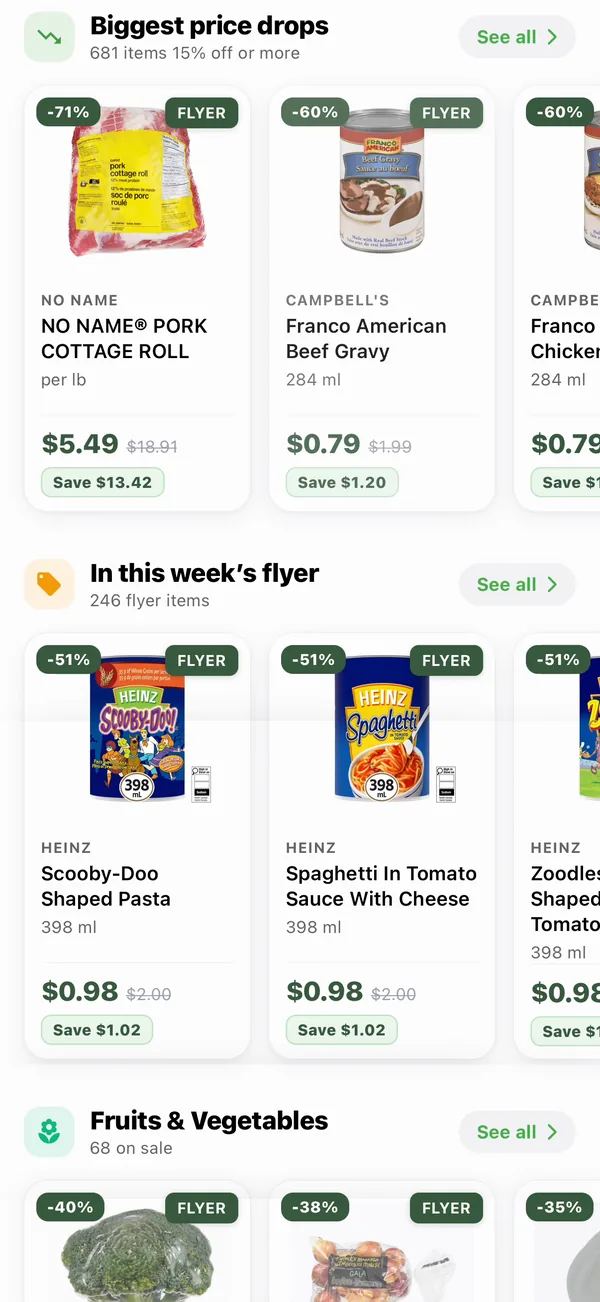
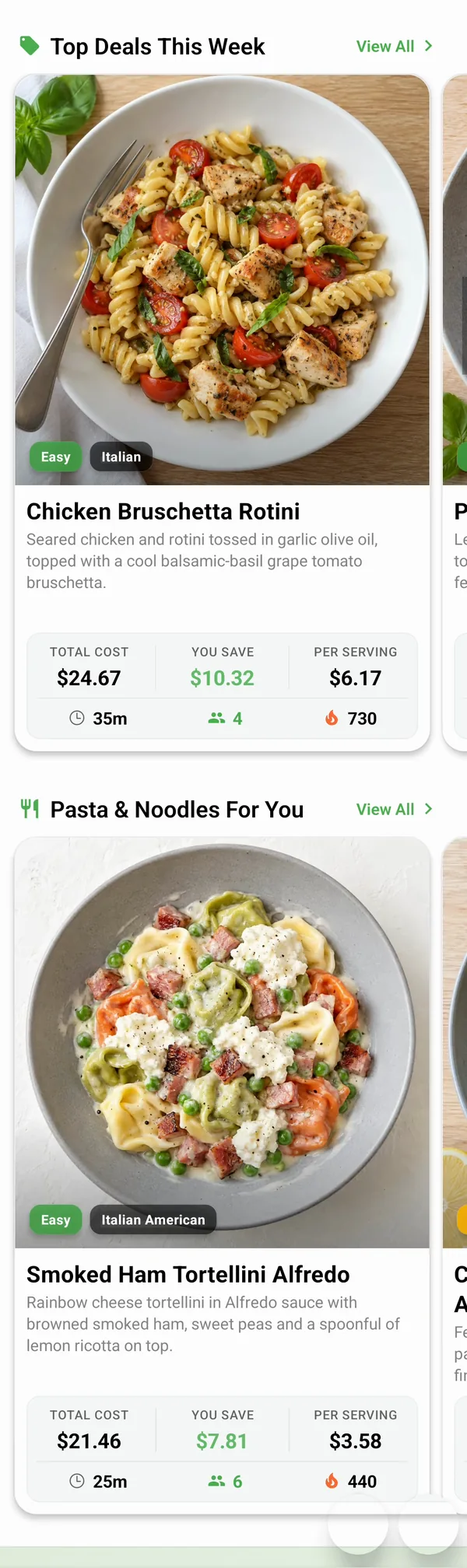
Deal Dish is a free app for iPhone, iPad and Android that shows this week's flyer deals at 3,500+ Canadian grocery stores across 35 banners. It builds recipes from the proteins and produce on sale at your store, shows each recipe's cost per serving and savings, and turns the recipes you pick into a shopping list.
See this week's grocery deals at your store. Download Deal Dish free on the App Store.
Put this into practice
Deal Dish is a free app for iPhone, iPad and Android that collects weekly flyer deals from 3,500+ Canadian grocery stores. The same team writes these guides.