5 Meal Planning Strategies That Actually Save Money
Five meal-planning strategies for Canadian grocery shoppers that hold up past week three: flyer sales, batch cooking, the freezer and the centre aisles.
Meal plans tend to slip by the third week. You're tired, you missed the day you planned to shop, and you're ordering takeout because the chicken you bought is still frozen.
The five strategies below are built for Canadian grocery shopping: weekly flyer cycles, in-season produce and ordinary ingredients. They also fit 2026's pressures, with food prices forecast to rise 4% to 6% this year (Canada's Food Price Report 2026) and beef pushed up by Canada's smallest cattle herd since the late 1980s (Dalhousie). Trade friction on upstream inputs like packaging and logistics adds to the pressure.
Strategy 1: Build the week around two proteins on sale
A lot of "plan your meals" advice has the order backwards. The standard script is: pick recipes you want, write down ingredients, go shop. The cheaper script flips it: see what protein is on deep sale this week, then design three to four meals around it.
Protein is usually the most expensive part of a meal. The Food Price Report 2026 found meat rose 5% to 7% in 2025, faster than it had forecast, and expects chicken prices to rise substantially this year.
If chicken thighs are on a deep sale this week, build half your meals around chicken. For reference, chicken thighs averaged $12.31/kg across Canada in February 2026 (Statistics Canada), so a flyer price well below that is worth building around. If pork shoulder is cheap, make it a slow-cooker week with pulled-pork sandwiches.
The meals don't have to taste similar. One protein can become:
- Chicken thighs: sheet-pan with potatoes Monday, tikka masala Wednesday, soup with rice Friday.
- Ground beef (or turkey, when beef is expensive): tacos Sunday, pasta sauce Tuesday, stuffed peppers Thursday.
- Pork shoulder: roasted with vegetables Saturday, pulled-pork sandwiches Monday, fried rice Wednesday.
- Lentils or chickpeas (a good 2026 default): dal Monday, lentil soup Wednesday, curry bowls Friday.
You cook the same protein three different ways across the week. You keep variety while buying one protein at its sale price instead of three at regular price.
Strategy 2: Cook once, eat three times
Batch cooking gets a bad reputation because the version pushed online (meal prep Sunday, then the same chicken and broccoli Monday through Friday) is grim by Wednesday.
The version that works: batch a base and change the finish.
Examples:
- Big pot of cooked rice on Sunday. Becomes a stir-fry Monday, a rice bowl Wednesday, fried rice Friday.
- Sheet of roasted vegetables (squash, peppers, onions, carrots) on Sunday. Becomes a grain bowl Monday, a frittata Tuesday, soup on Thursday.
- Slow-cooker beans (a pound of dried, cooked with broth and aromatics). Becomes chili Monday, burrito filling Wednesday, soup with greens Friday.
- A whole roasted chicken on Sunday. Becomes sandwiches Monday, soup from the carcass Tuesday, salads Wednesday.
These are three different meals built from one cooking session. The base ingredients are bought once, at one price.
Strategy 3: Get freezer math right
The freezer lets you buy at stock-up prices without rushing to cook everything before it goes bad.
What freezes well, with Health Canada's quality times where it lists them (Health Canada):
- Raw chicken pieces (stock-up purchase): about 6 months.
- Raw ground meat (in 500 g portions): 2–3 months.
- Cooked soups: about 4 months. Freeze in portion-size containers.
- Cooked stews and leftovers: 2–3 months.
- Hard cheese: up to a year. Grate it first for cooking.
- Cooked grains and beans: freeze flat in zip-top bags so they thaw fast.
- Bread: slice first and toast straight from frozen.
- Berries, banana slices, mango chunks: use in smoothies and baking.
What doesn't freeze well:
- Lettuce, cucumber, fresh herbs (freeze herbs in oil in an ice-cube tray instead)
- Cooked pasta (turns mushy)
- Mayo-based sauces and cream-based soups (they can split when thawed)
- Soft cheeses
The strategy: when a stock-up price hits, buy two or three weeks' worth, portion it and freeze it. For the next few weeks, you're paying the sale price for that ingredient instead of the regular price.
Strategy 4: The "shop the perimeter" advice is mostly wrong
A common grocery-budget tip is to "shop the perimeter" of the store, where produce, meat and dairy live, and avoid the centre aisles. The argument: centre aisles are processed food, the perimeter is whole food.
That advice is aimed at nutrition, and it can push your budget the wrong way.
Fresh produce and fresh meat spoil fastest and swing most in price from week to week. The centre aisles hold some of the cheapest meal-builders in the store: pasta, rice, beans, canned tomatoes, oats, lentils and frozen vegetables. A 900 g bag of dried lentils averaged $3.56 across Canada in February 2026 (Statistics Canada).
The budget version: build the carbohydrate and protein backbone of your week from the centre aisles (pasta, rice, beans, lentils, frozen meat, frozen vegetables). Use the perimeter for freshness and flavour (a few fresh vegetables, herbs, a wedge of cheese).
Lentils, beans, oats, rice, pasta, canned tomatoes and frozen vegetables are some of the cheapest meal-builders in any Canadian grocery store. Build half your meals around them.
Strategy 5: Plan around the store's rotation
The hard shift in budget meal planning is choosing meals by what's cheap this week before what you feel like eating.
It's less restrictive than it sounds, because what's on sale changes every week. A weekly flyer usually includes some meat on a real sale, some seasonal produce and some pantry staples.
The shift is from "I want chicken parmigiana tonight, let me see what it costs" to "what's on sale this week, and what can it become?"
A weekly habit:
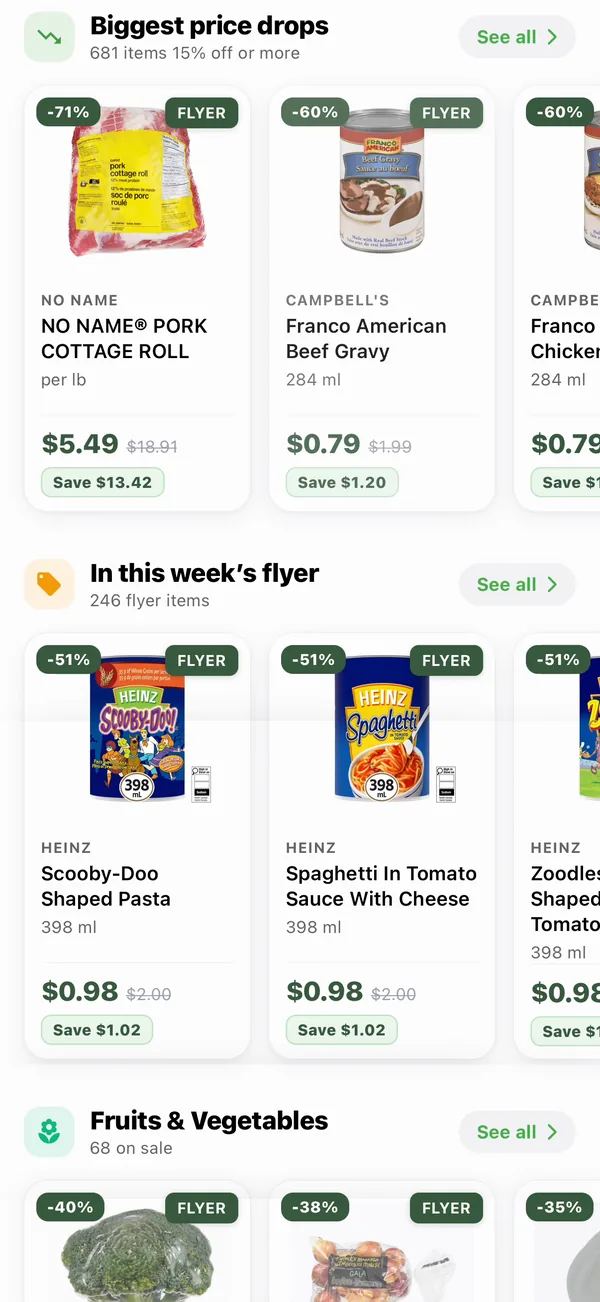
- Thursday or Friday: Open the flyers (or the Deal Dish app). Note which proteins, produce and pantry items are at real sale prices.
- Pick 2 proteins, 4 produce items and 2 pantry items. Don't pick recipes yet.
- Now sketch 4 dinners that use combinations of those ingredients. Two should batch into multiple meals.
- Plan a no-cook Friday. Eggs, leftovers, frozen pizza or takeout: whatever doesn't need you to be a hero on day five.
The plan holds up past week three because it doesn't depend on getting every night right.
The grocery list discipline
A good list:
- Is sectioned by store layout (produce, meat, dairy, dry goods)
- Includes quantities, not just items ("2 L milk," not "milk")
- Has a "maybe" section for unplanned deals
- Gets followed inside the store
A list you actually follow keeps impulse buys out of the cart.
The 2026 seasonal shift
One 2026 adjustment: lean harder into Canadian-grown seasonal produce.
Between February 2025 and February 2026, the average price of bananas (all imported) rose 10.8% and tomatoes rose 11.8%. Over the same period, potatoes, carrots and cabbage fell more than 8% (Statistics Canada). Your meal plan should reflect that.
The 2026 low-volatility basket
Some staples barely moved, or got cheaper, between February 2025 and February 2026 (Statistics Canada). Use them as the pantry and freezer backbone of the week:
- White rice (up 0.8%)
- Dried lentils (down 4.3%) and dry beans (up 0.6%)
- Potatoes, carrots, onions and cabbage (down 4.6% to 8.8%)
- Eggs (down 2.0%)
- Chicken or pork, when they're on a real sale
Build roughly half the week around these, and the imported or volatile items you still want become accents.
Don't let groceries go to waste
Stock-up buying only saves money if you use what you bought. Portion it, freeze it or cook it before it turns. Buy aggressively on what you use every week, and be conservative on the rest.
How Deal Dish helps
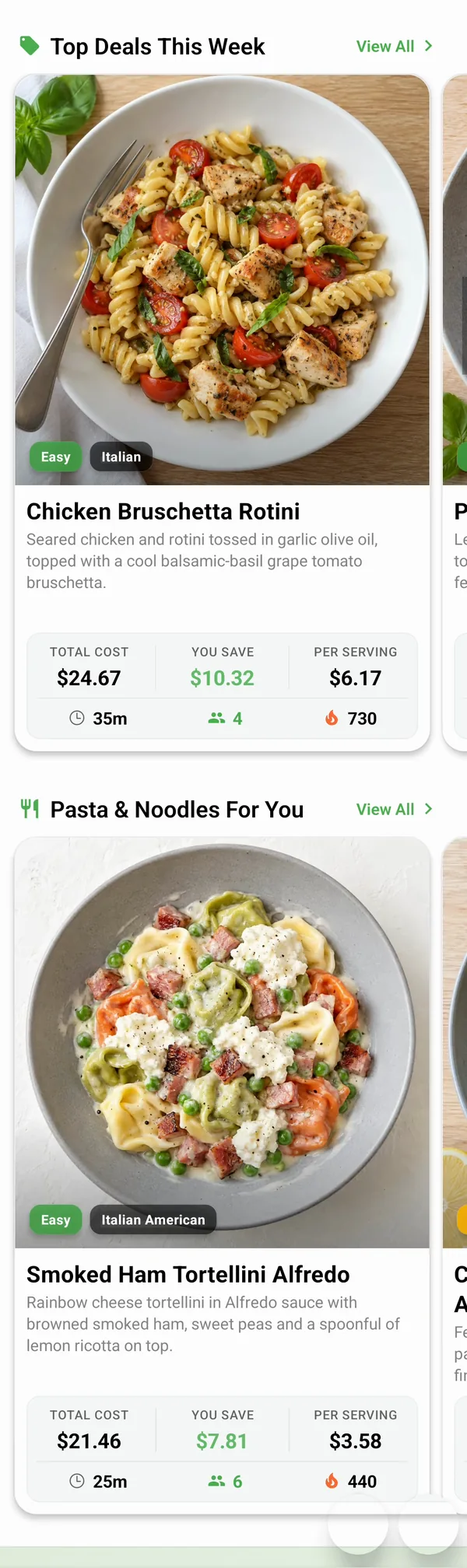
Deal Dish is a free app for iPhone, iPad and Android that shows this week's flyer deals at 3,500+ Canadian grocery stores across 35 banners. Every Thursday it adds 500+ new recipes built from what's on sale, and each recipe card shows its cost, cost per serving and savings.
Add the recipes you like to your plan and Deal Dish builds your shopping list, which you can view by recipe, aisle or store.
Start each week's plan from the deals at your store. Get Deal Dish free on the App Store.
Put this into practice
Deal Dish is a free app for iPhone, iPad and Android that collects weekly flyer deals from 3,500+ Canadian grocery stores. The same team writes these guides.