Canada's Discount Grocers in 2026: Where Each Chain Wins
No Frills, Food Basics, FreshCo, Giant Tiger, Maxi, Walmart and Costco: where each tends to win, why "discount" isn't always cheapest, and how to test your stores.
Canada's Food Price Report 2026 forecasts food prices rising 4% to 6% this year and projects a family of four will spend $17,571.79 on food (Dalhousie). That makes your choice of discount banner worth getting right: No Frills, Food Basics, FreshCo, Maxi, Giant Tiger, Walmart or Costco.
Price differences between discounters are real, but they're category-specific. The cheapest store for meat may not be the cheapest for produce.
"Discount" also doesn't mean cheapest in every aisle. A full-service chain's flyer leader can beat a discounter's everyday price for a week, and Costco competes on a different model (bulk packs and a membership fee).
This guide covers where each chain tends to be strongest and how to test that against the stores near you.
Build your own reference basket
Prices vary by region, week, store and promotion. The ranking that matters is the one for the stores you can actually get to.
A reference basket gives you a fair comparison. Here's one you can copy:
Proteins: boneless chicken thighs, lean ground beef, whole chicken, pork shoulder roast, eggs (dozen, large), canned tuna (170 g).
Dairy: 2% milk (4 L), salted butter (454 g), cheddar cheese (400 g block), plain yogurt (750 g).
Produce: carrots (5 lb bag), potatoes (10 lb bag), yellow onions (3 lb bag), 1 head cabbage, bananas (per lb), apples (per lb), 1 pint strawberries, greenhouse cucumber, oranges (5 lb bag).
Pantry: flour (2.5 kg), white rice (2 kg), dried pasta (500 g), canned tomatoes (796 mL), olive oil (1 L), peanut butter (1 kg), oatmeal (1 kg), bread (loaf), ground coffee (908 g).
Frozen: mixed vegetables (1 kg), frozen berries (600 g).
Price it at two or three nearby stores. Use each store's cheapest option (often the store brand for pantry items) and this week's flyer prices.
For Costco, compare unit prices instead of sticker prices, since a 4 L jug and a 500 mL bottle aren't comparable. Repeat over a few weeks, because one strong flyer week can reshuffle the order.
Discount stores aren't automatically cheapest in every category
Before the chain-by-chain notes, a reality check:
- Discount banners are built around lower everyday pricing on pantry basics: flour, rice, pasta, oats and canned goods.
- Flyer leaders at full-service chains can make Loblaws, Metro or Sobeys the cheaper stop for specific promoted items, especially meat.
- The cheapest total basket often comes from combining one low-everyday-price store (a discounter or Costco) with one flyer-driven trip for that week's best deals elsewhere.
If you shop one banner only because it's cheapest "on average," you'll pay more on the items it doesn't win.
What discount stores are actually best at
Costco
Costco's strength is unit pricing on large packs of protein, pantry staples, butter and cheese, as long as you use them before they go off. Produce is harder, because pack sizes are often too big for a household to finish.
A Gold Star membership costs $65 a year, up from $60 in September 2024 (blogTO). Executive members pay more and get an annual 2% reward on most purchases (Costco).
Use Costco as: your source for proteins, pantry staples and freezer stock-ups. To check the fee, divide $65 by what you save on a typical Costco run. That's how many runs it takes to break even.
No Frills / Maxi / FreshCo / Food Basics
These are weekly-shop discounters. They run flyer specials on proteins, dairy and produce on top of lower everyday prices than their full-service sister chains.
Loyalty offers lower the effective price further if you load them: PC Optimum at No Frills and Maxi, Scene+ at FreshCo, and Moi Rewards at Food Basics (where Moi earns through bonus offers only, with no base rate, per Rewards Canada).
Use these as: your default weekly-shop stores, with stock-ups when their featured proteins line up.
Walmart
Walmart's Great Value store brand covers most pantry staples. A Supercentre trip lets you combine groceries with cleaning supplies, toiletries or pharmacy in one stop.
Use Walmart as: a rotation option, especially when you're buying non-food too. Walmart Canada only matches the Walmart.ca price on identical items, not competitor flyers (Walmart Canada), so don't plan a price-matching strategy around Walmart in-store.
Real Canadian Superstore
Superstore is a discount-leaning supercentre more than a pure discounter. It carries President's Choice and No Name across nearly every category, in a large format built for one-stop trips.
Use RCSS as: a broad-range one-stop option when you'd rather not split trips.
Regional / specialized picks
Giant Tiger
Giant Tiger is a Canadian-owned discount chain that sells groceries alongside household goods and clothing. Its "Giant Value Guarantee" beats a local competitor's advertised price on identical items by a cent (MapleMoney).
Use Giant Tiger as: a pantry-staples stop, especially if it's the discount option closest to you.
Maxi (Quebec)
Maxi is Loblaw's Quebec discount banner, and it uses PC Optimum.
Use Maxi as: your default Quebec discount store, then compare against Super C on the week's flyers.
Metro-family discount (Super C, Food Basics)
Food Basics (Ontario) and Super C (Quebec) are Metro's discount banners. Their loyalty program is Moi Rewards, which replaced Air Miles at Ontario Metro and Food Basics stores in October 2024 (Metro). Worth knowing if you're still carrying the old card.
Full-service chains still win some weeks
Outside promotional weeks, Sobeys, Loblaws, Metro and IGA usually charge more than discount banners on comparable items. That doesn't rule them out. When their flyer lands a real protein loss leader or a deep pantry discount, they can be the cheapest trip that week.
If you shop a full-service banner by default (not because of proximity, a specific item or a strong flyer), you're likely paying more on the items that aren't on sale.
Why one-store shopping usually loses
Even the best banner isn't the cheapest for everything. The cheapest meat store may not be the cheapest produce store in the same week. The lowest everyday pantry prices may sit at a store with a weak fresh-food flyer.
The lowest-cost basket usually comes from combining:
- One low-everyday-price store (a discount banner or Costco) for staples, pantry and freezer proteins.
- One flyer-driven trip to whichever banner has that week's best protein and produce deals.
Four stores a week is a lot to juggle. Two is manageable.
The Costco-specific math
A fair Costco comparison has to handle two things basket totals miss:
Bulk-size adjustment. Costco's olive oil may be cheaper per mL, but if the bottle doesn't fit your cupboard or outlasts its shelf life, the saving disappears. The math only works on items you'll use while they're fresh.
Brand flexibility. Costco carries fewer brands than a weekly-flyer store. You'll get more from it if you're willing to switch to Kirkland Signature in key categories and portion and freeze large packs of protein.
When it fits your household, a monthly Costco run plus a weekly discount-grocer trip for fresh food is an efficient setup.
The two-store strategy
A two-store routine looks like this:
-
Monthly Costco or RCSS stock-up run. Proteins (for the freezer), pantry staples (rice, flour, olive oil, coffee, oats), dairy (butter, cheese) and household non-food.
-
Weekly discount grocer trip. No Frills, Walmart, FreshCo, Food Basics or Maxi for produce, fresh meat, dairy top-ups and flyer leaders.
If you do your full weekly shop at a full-service banner by default, try moving that trip to a discount banner (No Frills, FreshCo, Food Basics, Maxi or Walmart) first. Flyer strategy, coupons and loyalty offers then stack on top of a lower base price.
Where regional differences matter
Atlantic Canada: Sobeys and Atlantic Superstore are the main full-service chains. Giant Tiger, No Frills and Walmart are the discount options to compare.
Quebec: Maxi and Super C are the main discount banners, with Costco for bulk. Metro, IGA and Provigo are the full-service alternatives. Moi Rewards is the loyalty program at Metro and Super C.
Ontario: No Frills, FreshCo, Food Basics, Giant Tiger, Walmart and Costco all compete, so many shoppers have several discount options within reach.
Prairies: No Frills, Real Canadian Superstore, Walmart Supercentre and Save-On-Foods are common, and Costco operates in the major cities.
British Columbia: Save-On-Foods is a major full-service chain, with Real Canadian Superstore and Walmart as discount alternatives. No Frills has a smaller footprint than in Ontario.
How Deal Dish helps
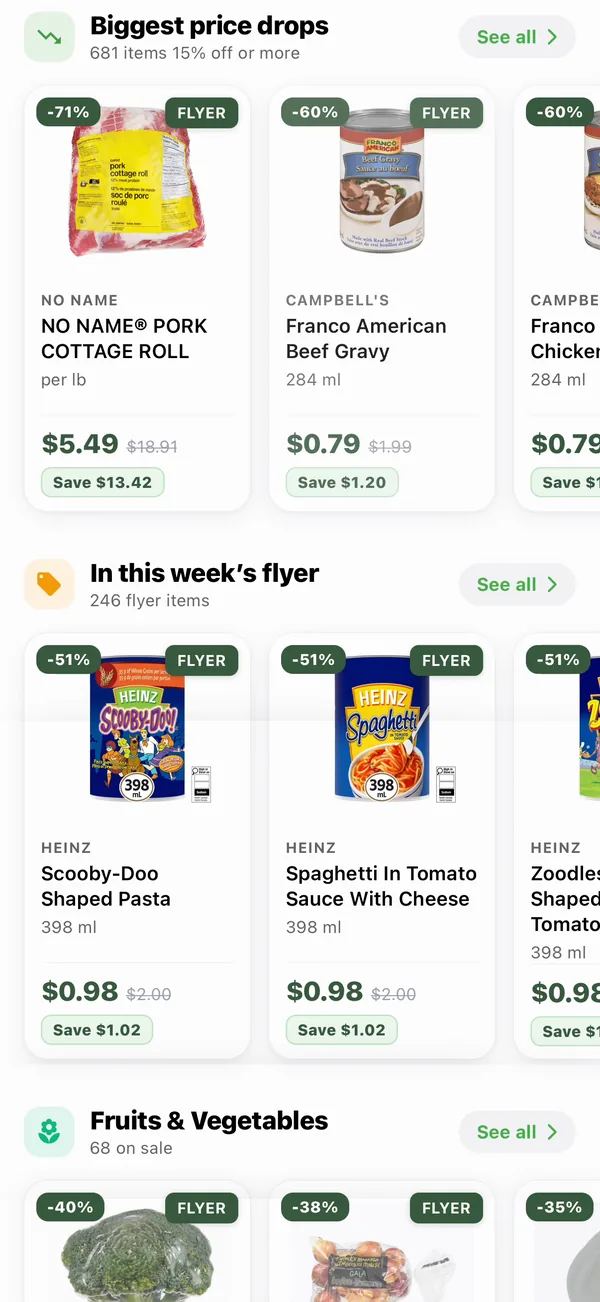
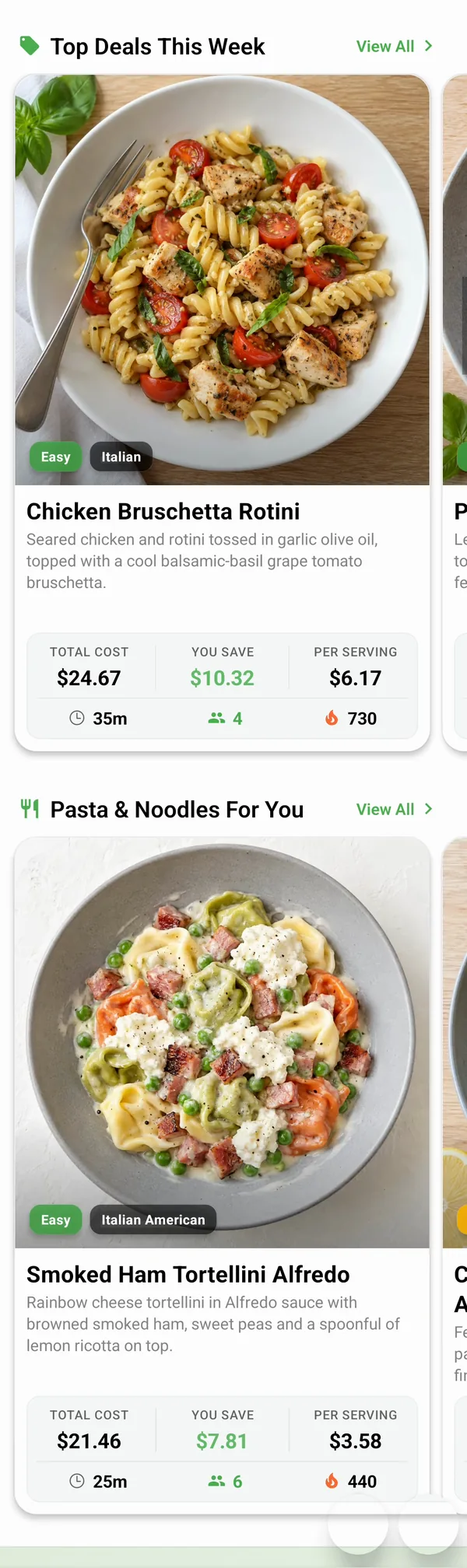
Deal Dish is a free app for iPhone, iPad and Android that shows this week's flyer deals at 3,500+ Canadian grocery stores across 35 banners, including No Frills, FreshCo, Food Basics, Maxi and Super C. You can compare prices at nearby stores, which lets you check your reference basket against this week's flyers.
Compare this week's grocery deals at stores near you. Get Deal Dish free on the App Store.
Put this into practice
Deal Dish is a free app for iPhone, iPad and Android that collects weekly flyer deals from 3,500+ Canadian grocery stores. The same team writes these guides.