The Smart Shopper's Guide to Reading Grocery Flyers
Loss leaders, multi-buy framing, shrinkflation and stock-up prices: how to read a Canadian grocery flyer and pick out the deals that actually save you money.
A grocery flyer is a sales document. Its job is to bring you into the store and move specific products. Some items in it are great deals, some are ordinary prices dressed up as deals, and most fall somewhere in between.
If you read a flyer the way the chain's buyers do, you can pick out the cheap items and skip the urgency that gets shoppers spending more than they planned. With food prices forecast to rise 4% to 6% in 2026 (Canada's Food Price Report), that skill matters more this year. (We explain what's driving the increase separately.)
Here's how to do it.
The front page is the bait
Look at the front cover of any flyer from No Frills, Loblaws, Real Canadian Superstore, Metro or Sobeys. You'll see one or two products in giant type at prices well below what you usually pay, such as a whole chicken, a pint of strawberries or a frozen pizza.
These are loss leaders. They're sold at very thin margins, sometimes below cost, to get you in the door. Once you're in the aisles, the store hopes you'll fill the cart with other items at regular price.
Loss leaders are real deals. Buy them, and stock up if they freeze. Just don't let them tie you to one store every week, because the loss leader rotates and competitors run their own.
The structure of a typical flyer
Many Canadian grocery flyers follow a similar layout:
- Page 1 (front cover): 1–3 headline deals, usually the biggest of the week.
- Pages 2–3 (produce and meat): mid-tier deals on items the store is pushing this week. Often good, rarely spectacular.
- Middle pages (centre-store and dry goods): brand promotions. Sometimes excellent (case-pack drinks, paper towels), often modest.
- Back cover: a second headline deal or a seasonal page.
Read the middle pages carefully. That's where ordinary prices are most likely to be dressed up as deals.
Decoy pricing: how "$5 for 3" tricks you
You've seen this one: 2 for $5 or 3 for $9.99. The framing suggests you have to buy multiples to get the price.
Some multi-buy offers price each unit at the deal price, so "2 for $5" means $2.50 each and you can buy one. Others require the full quantity, and "buy 2 get 1 free" deals always have a threshold. The shelf tag or the flyer fine print tells you which kind you're looking at.
The bundle is there to get you to buy more than you planned. Read the tag, do the division, and decide on the per-unit price.
Use unit pricing as your first check
Unit pricing is the small "per 100 g", "per litre" or "per 100 mL" number on the shelf tag. It's one of the best tools for comparing deals across sizes, brands and package formats.
Unit pricing isn't mandatory across Canada. Quebec is the only province that requires it; retailers elsewhere show it voluntarily or not at all (CBC News). When it's missing, divide the sticker price by the package weight on your phone.
Watch for shrinkflation
The same sticker price doesn't always mean the same value. Statistics Canada found 29.6% of eligible grocery items tracked in the CPI shrank in size between 2021 and 2023 (Statistics Canada). Margarine, pasta mixes, cookies and crackers, mozzarella, breakfast cereal and cheddar had the most cases.
The fix is the same as for multi-buy math: compare the cost per 100 g, per litre or per item. If last month's deal was $3.99 for 500 g and this month's "same deal" is $3.99 for 450 g, the unit price is up about 11% even though the sticker hasn't moved. See our full shrinkflation piece for more ways to catch it.
Stock-up vs. weekly prices
Experienced shoppers learn the difference between "cheap this week" and "as cheap as this gets."
A useful starting point is Statistics Canada's monthly average retail price. Averages include sale prices, so a flyer price well below them is worth a closer look. Ontario averages for February 2026 (Statistics Canada):
- Chicken breasts: $12.96/kg
- Ground beef: $16.13/kg
- Block cheese (500 g): $6.92
- Olive oil (1 L): $10.77
- Pasta sauce (650 mL): $3.03
- Ground coffee (340 g): $9.39
Then watch the items you buy most for two or three months and note the lowest flyer price you see. That low is your stock-up price. When it comes back, buy enough to last until the next one.
How to tell whether a flyer item is really a stock-up price
Three quick tests before you stockpile:
- Compare against recent sale prices, not just the regular price. A "50% off!" that matches the sale price from six weeks ago isn't a stock-up event.
- Check the unit price. A "stock-up" on a package that's quietly shrunk may cost more per unit than the last real low.
- Only buy deep on products you'll use before they go off. A cheap jar of pasta sauce is only a deal if you eat pasta sauce.
Endcap pricing isn't always sale pricing
Endcaps are the displays at the end of each aisle. Bright signs and big prices make them look like sale displays, but the product there is often at regular price, just placed where you'll see it.
The shelf tag is what counts. If there's no sale tag, it's not on sale.
The asterisk problem
You'll often see a flyer price with a small superscript: $3.99* or $1.49*. Read the fine print at the bottom of the page. Common asterisks:
- "When you buy any 3 participating items"
- "With purchase of $50 or more"
- "Member price, sign in required"
- "Limit 2 per customer"
The first three are conditions that can change what you actually pay. The fourth is a cap worth knowing about. Read the fine print before you count on the price.
1) Check the cover's loss leaders and note any worth a trip. 2) Skim the middle pages, ignore "2 for $X" framing, and look at the per-unit math. 3) Check the stock-up categories you actually use. 4) Skip everything else.
Loyalty programs change the math
PC Optimum (Loblaws, No Frills, Real Canadian Superstore, Shoppers Drug Mart and other Loblaw banners), Scene+ (Sobeys, Safeway, IGA, FreshCo, Foodland and more, per Scotiabank) and Moi Rewards (Metro and Food Basics in Ontario since October 2024, per Metro) all change flyer math. A "$3.99" item might come with a personalized points offer that lowers your effective cost.
Two practical rules:
- Load your personalized offers. They're targeted at items you already buy, and they can stack on top of the flyer price.
- Don't switch stores just for points. Treat points as a bonus on shopping you were going to do anyway.
For a full breakdown, see our loyalty program comparison.
Price matching multiplies flyer value
Several Canadian discount banners match competitors' advertised prices, each with its own rules. No Frills, FreshCo and Real Canadian Superstore all have price-match policies (NerdWallet), and Giant Tiger's "Giant Value Guarantee" beats a local competitor's advertised price by a cent (MapleMoney).
The details matter. Qualifying competitors are usually limited to your store's local trade area, the item must be identical (brand and size), and limits of four units are common.
Walmart Canada ended competitor ad matching in 2020. It now matches only the Walmart.ca price on identical items (Walmart Canada), so don't build a price-match plan around Walmart in-store. See our Price Matching in Canada guide for the per-retailer breakdown.
Pricing errors are real and refundable
Retailers that follow the voluntary Scanner Price Accuracy Code give you a set remedy when an item scans higher at checkout than the shelf or flyer price (Competition Bureau):
- The item free if it's under $10
- $10 off if it's $10 or more
Signatories include Loblaw, Sobeys, Metro, Walmart Canada and Costco (MoneySense), but not every retailer has signed on. Check your receipt, especially right after a promotion ends, when an item can still scan at the old regular price.
Weekly cycle planning
Many Canadian grocery flyers start on Thursday or Friday. Timing varies by retailer and region, so check the dates printed in the flyer. If you plan your shopping on Thursday or Friday, you're working with the newest deals.
Late in the flyer week, watch for markdowns on meat and produce that didn't sell at the sale price, before the next flyer starts.
How Deal Dish helps
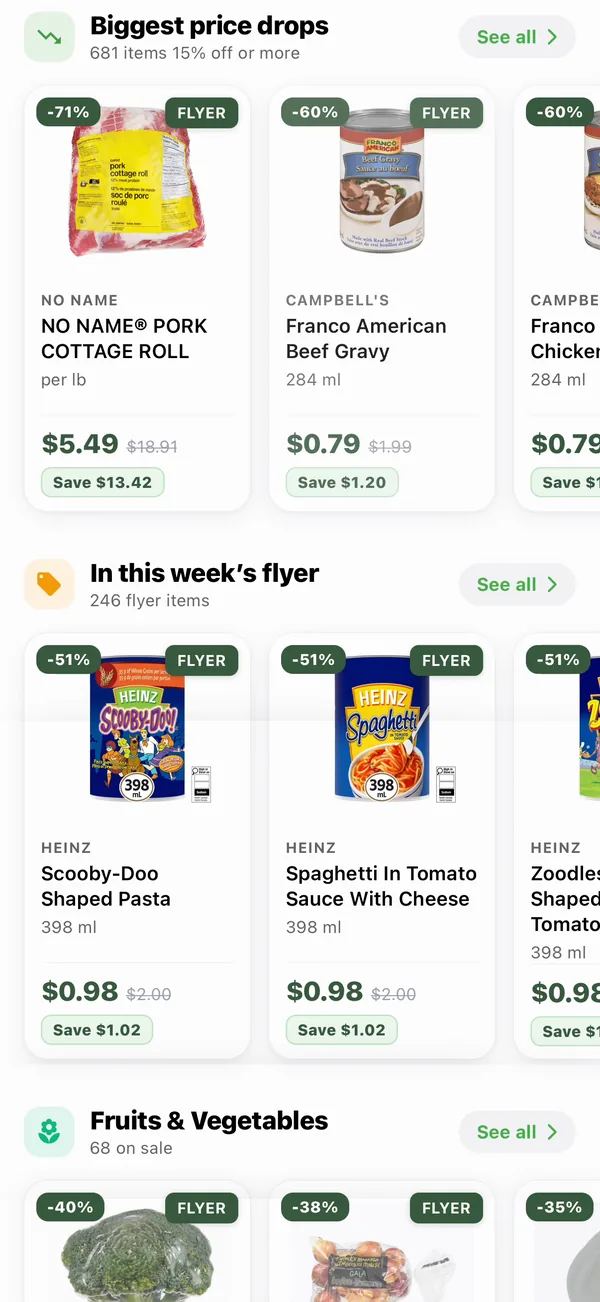
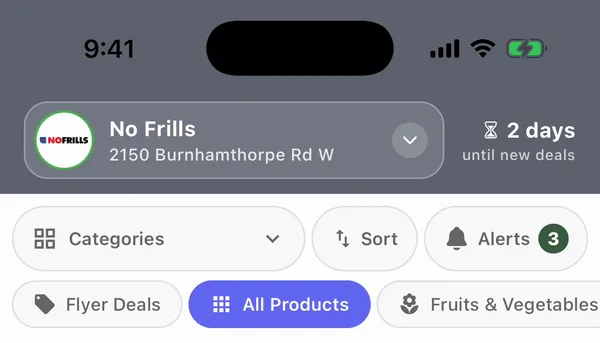
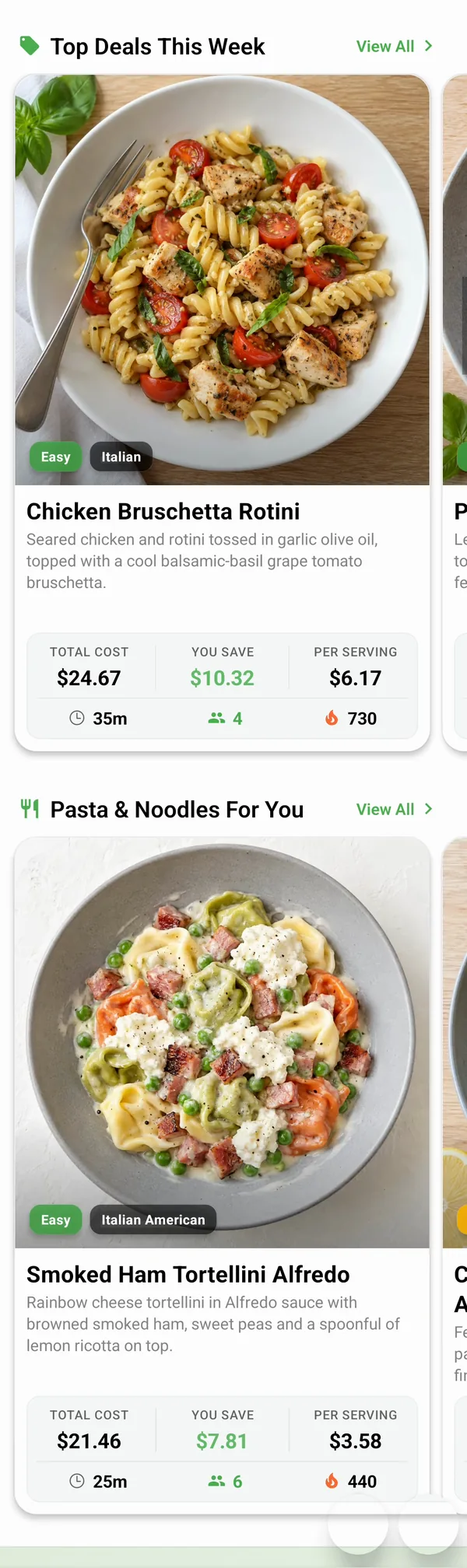
Deal Dish is a free app for iPhone, iPad and Android that shows this week's flyer deals at 3,500+ Canadian grocery stores across 35 banners. You can compare prices at nearby stores, set sale alerts, and get recipes built around what's on sale, with the cost per serving on each recipe.
See this week's flyer deals from 35 Canadian grocery banners in one app. Get Deal Dish free on the App Store.
Put this into practice
Deal Dish is a free app for iPhone, iPad and Android that collects weekly flyer deals from 3,500+ Canadian grocery stores. The same team writes these guides.